Writing is a marketable skill. Smiling is a remarkable skill.
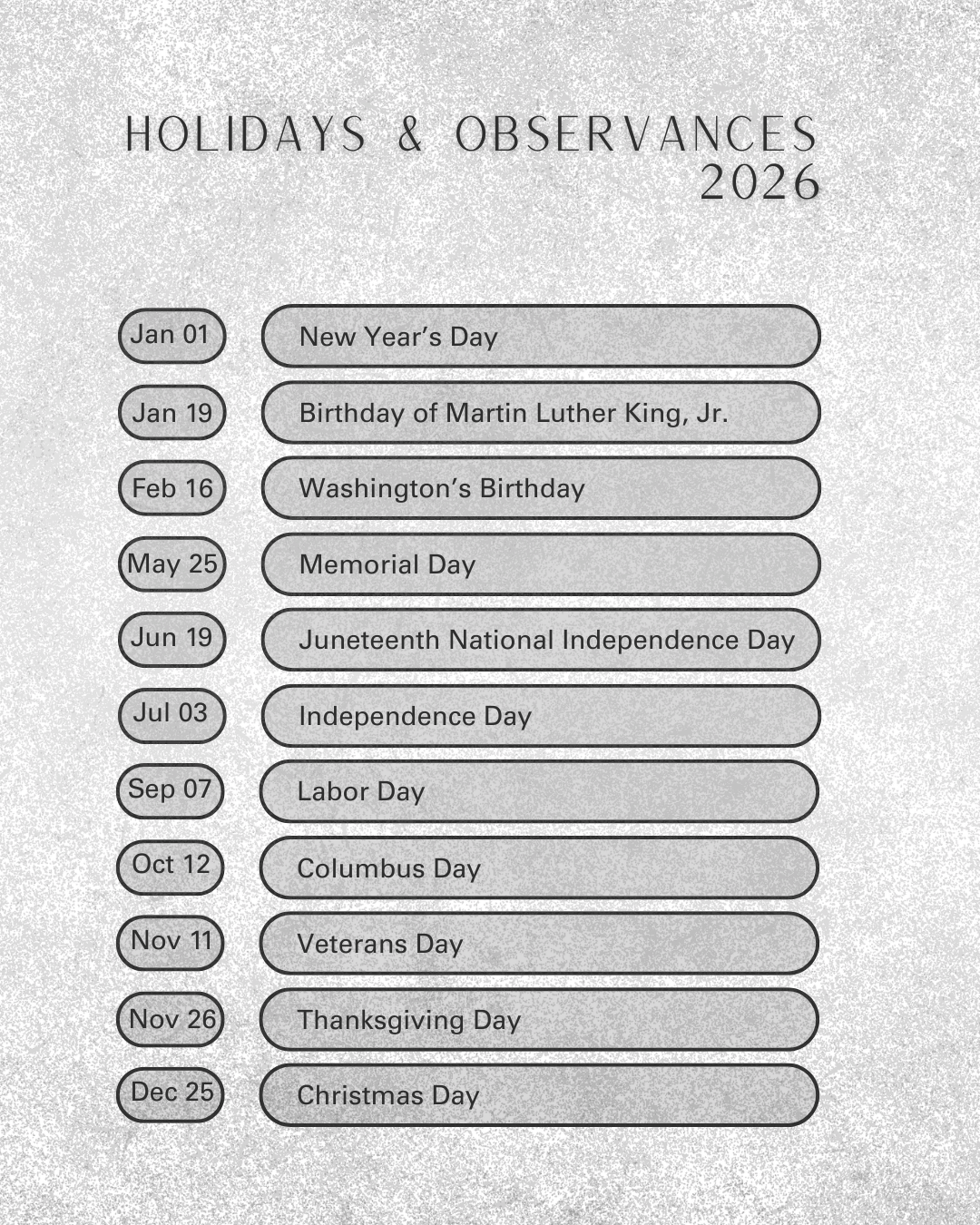
Holidays & Observances in 2026
Q1
On June 28, 1870, Congress enacted four holidays for federal employees in the District of Columbia: New Year's Day, Independence Day, Christmas and "any day appointed or recommended by the President of the United States as a day of public fasting or thanksgiving."
Y'all, the country had celebrated 94 years of independence before the Fourth of July was a federal holiday.
Congress establishes federal holidays. The Office of Personnel Management (opm.gov), being the HR Department of the U.S. government, keeps track of the dates and particulars. For a list of the 11 federal holidays for the past 15 years and the next few years, click here. The USPS calendar has the same for dates for post office closures.
J A N U A R Y
New Year’s Day The first day of the new year is always celebrated on January 1. One year, singular possessive.
Birthday of Martin Luther King, Jr. We call it Martin Luther King Day or MLK Day, but the official name is “Birthday of Martin Luther King, Jr.”
It is celebrated on the third Monday of January. In 1983, President Ronald Reagan signed the federal holiday into law to honor Martin Luther King. Born on Jan. 15, 1929, King was a Baptist minister, advocate and activist for civil rights, and recipient of the 1964 Nobel Peace Prize.
F E B R U A R Y
Washington’s Birthday There is no official holiday with the name Presidents Day.
The third Monday in February is a federal holiday called Washington's Birthday.
President George Washington was born Feb. 22, 1732. That date was officially honored by Congress in 1879. Since the Uniform Monday Holiday Act took effect in 1971 (having been passed in 1968), Washington's Birthday has been commemorated on the third Monday of February.
Abraham Lincoln was born Feb. 12, 1809, a day still recognized in certain states.
As for Presidents Day or Presidents' Day, there's no official source because it isn't an official government name. Whether you use the possessive form with a plural apostrophe (Presidents' Day) or the attributive (Presidents Day), just be consistent throughout your documents and materials.
M A R C H
Spring forward. Since 2007, the time has changed semiannually at 2 a.m. on the second Sunday of March and on the first Sunday of November. (It used to be the first Sunday in April and last Sunday in October.)
In March, daylight saving time begins (no ‘s’ on the end of ‘saving’). DST is not observed in Hawaii, most of Arizona, or the five U.S. territories of American Samoa, Guam, Northern Mariana Islands, Puerto Rico, U.S. Virgin Islands.
Timely trivia: North American time zones were developed in 1883 by railroad companies in the United States and Canada. In 1918, federal law established the Standard Time Act and the Interstate Commerce Commission was responsible for setting and overseeing geographical boundaries of time zones. Congress passed the Uniform Time Act in 1966, which is overseen by the Department of Transportation (also formed in 1966).